How to Price a Federal Construction Bid
How to Price a Federal Construction Bid
Pricing private construction work and pricing a federal construction bid are not the same exercise. Contractors who move across without adjusting either lose every bid on price or win one and discover halfway through that the compliance costs they never priced are eating the job. Both outcomes are avoidable, and both come from the same root: federal work carries cost obligations that private work does not.
The short answer
Price a federal construction bid by building it from the solicitation rather than from your standard private estimate. Take off the scope from the drawings and specifications, price labor at the wage determination rates rather than your normal rates, add the compliance costs federal work requires — bonding, certified payroll administration, submittals, inspections — and only then apply overhead and profit. Skipping the wage determination is the single most common and most expensive error.
Key Takeaways
- Wage determinations set minimum labor rates, and they are not optional.
- Certified payroll is a genuine weekly administrative cost — price it.
- Bonding, submittals and government inspection cycles all consume time and money.
- Federal payment cycles are slower, so carrying cost belongs in the price.
- Never price a federal job by adding a percentage to your private number.
Start with the wage determination
Attached to most federal construction solicitations is a wage determination under the Davis-Bacon and Related Acts. It lists minimum hourly rates and fringe benefits by trade classification for the project's location. You must pay at least those rates, and the Department of Labor publishes the applicable rules and determinations.
For contractors whose normal rates are below determination rates, this alone can change the labor line substantially. Contractors who price off habit rather than off the determination attached to that specific solicitation either bid too low and lose money, or bid a guess and lose the job.
Read the determination, map your crew classifications to it, and price the actual rates.
Price the compliance work, because it is real work
| Cost | What it involves | Frequently missed |
|---|---|---|
| Certified payroll | Weekly submission of payroll records | Yes — usually treated as free |
| Bonding | Bid, performance and payment bonds | Partially |
| Submittals | Product data, samples, approvals before work | Yes |
| Inspections and hold points | Government inspection scheduling and delays | Yes |
| Closeout documentation | As-builts, warranties, final paperwork | Yes |
| Site security and access | Badging, escorts, restricted hours | On secure sites, often |
The pattern is that everything administrative gets left out because in private work it is absorbed into general overhead. On federal jobs the administrative load is heavier and more rigid, and it needs to be a priced line rather than an assumption.
Restricted working hours deserve special attention. If a job can only be worked nights or weekends, or only when a facility is unoccupied, that changes productivity and often the wage rates too. The solicitation states these constraints and they are easy to skim past.
Take off from the drawings, not from experience
Federal specifications are more prescriptive than most private work. Named products, specific installation standards, specific testing. Assuming your usual assembly and pricing it is how contractors end up substituting materials that then fail submittal review.
Estimate what the specification actually requires. Where the specification and drawings conflict, submit a written question during the question period rather than pricing an assumption.
Add carrying cost for the payment cycle
Federal payment is generally reliable and generally slower than a private client who pays in two weeks. Progress payments run on a defined cycle, retainage may be held, and closeout can take time.
That gap is a financing cost. Contractors who ignore it win jobs that are profitable on paper and painful in the bank. Work out what carrying the job costs you across its likely payment timeline and include it.
Do not add a blanket percentage
The instinct is to take the private number and add fifteen or twenty percent for federal complexity. It fails in both directions. On labor-heavy jobs where the wage determination sits well above your usual rates, the uplift is not enough. On material-heavy jobs it can make you uncompetitive by a wide margin.
Build the estimate from the solicitation's own requirements. It is slower for the first few bids and it is the difference between a sustainable federal practice and a couple of painful contracts.
Build a checklist you reuse
After two or three federal bids the same line items recur, and the fastest way to stop losing money to omissions is a standing pricing checklist: wage determination applied, certified payroll administration priced, bonding priced, submittal preparation priced, inspection and hold-point time allowed, closeout documentation allowed, site access constraints reflected, and payment-cycle carrying cost included.
Run every bid against it before you submit. It takes ten minutes and it catches the omission that turns a won job into a loss.
Then decide whether to bid at all
Pricing properly sometimes tells you the job is not for you: the wage rates make you uncompetitive, the bonding exceeds your capacity, or the schedule constraints do not fit your crews. That is a useful answer, arrived at before you spent two weeks on a proposal.
If you are earlier in the process, how to get your first federal construction contract covers the sequence, and where to find federal construction bids covers finding solicitations sized for a first attempt.
The full pricing method is in the book
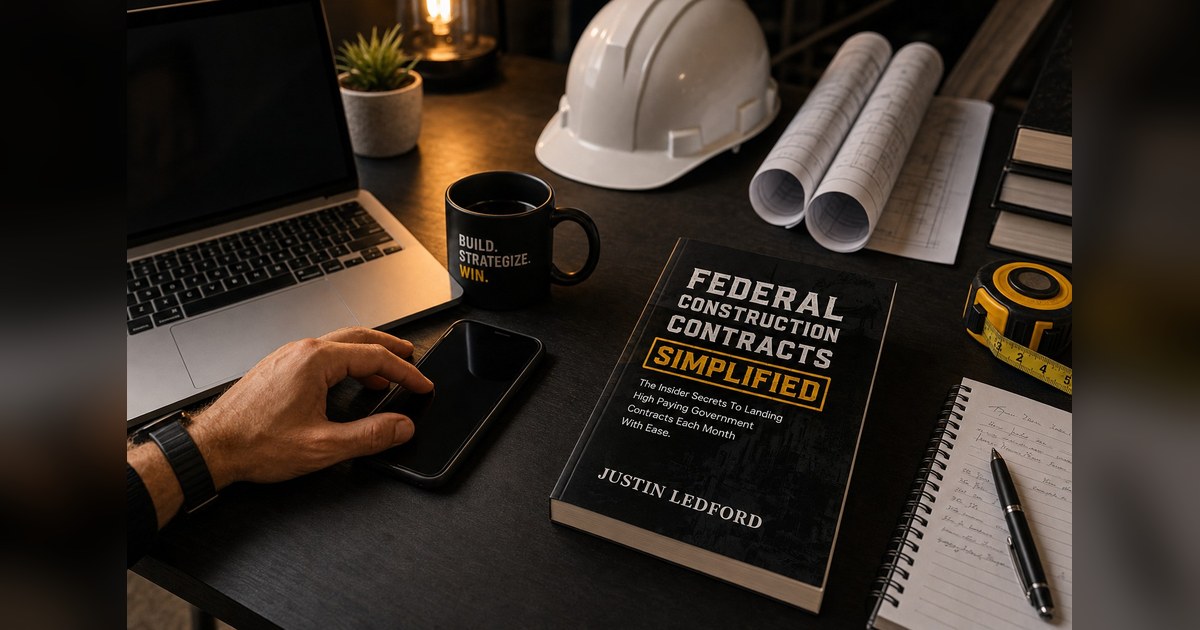
Federal Construction Contracts Simplified sets out the four-part government construction method, including how to build a compliant estimate from the solicitation rather than from a private baseline. It is $7.95, carries a 30-day guarantee, and it is not sold on Amazon.
Claim your digital copy for $7.95 before you price your next bid.