Where to Find Federal Construction Bids
You know the federal government buys billions in construction every year. What nobody tells you is where the work is actually posted, which listings are worth your time, and why the first three you find will be the worst possible place for a newcomer to start. Here is where to find federal construction bids, and how to read them before you waste a week writing a proposal you cannot win.
Where do you find federal construction bids?
Federal construction bids are posted on SAM.gov under Contract Opportunities, which is the single official source for solicitations above $25,000. Below that threshold, agencies buy through simplified procedures and often through the GSA and agency-specific portals. Past awards — who won, for how much, from which agency — are published separately on USASpending.gov, and that historical record is usually more useful to a new contractor than the live listings.
Key Takeaways
- SAM.gov Contract Opportunities is the official posting place. It replaced FedBizOpps (FBO) in 2019.
- Set up saved searches by NAICS code and location. Reading the whole board manually is a waste of your day.
- Award history on USASpending.gov tells you who keeps winning your work — that is your competitive intelligence, and it is free.
- Set-asides for small businesses are where a newcomer realistically wins. Full-and-open competition is not.
- Subcontracting to an existing prime is the fastest route to federal past performance.
The four places work actually shows up
1. SAM.gov Contract Opportunities. The official board. Every solicitation over $25,000 is posted here, along with sources sought notices, pre-solicitations and award notices. You need an active SAM.gov registration to bid, but you can search and read without one. Start at SAM.gov.
2. USASpending.gov. Not a bid board — an award database. You can see what a given agency actually bought, from whom, at what value, in your NAICS code and your region. For a contractor deciding whether federal work is even worth pursuing, this is more informative than the live listings, because it shows real demand rather than a single moment's snapshot. Search it at USASpending.gov.
3. Agency and installation portals. Some buying happens through agency-specific systems and through GSA vehicles. Large construction buyers — the Army Corps of Engineers, NAVFAC, Veterans Affairs, the General Services Administration — all post to SAM.gov, but they also publish forecasts of upcoming work that never appear as a solicitation until months later. Those forecasts are how experienced contractors get ready early.
4. Subcontracting to primes. Large federal construction contracts carry small business subcontracting plans, which means the prime is actively required to find businesses like yours. This is the least glamorous and most reliable first door. The SBA maintains subcontracting resources and the SBA's federal contracting guidance explains how set-asides and subcontracting programs work.
Which listings are worth your time
| Listing type | What it means | Worth it for a newcomer? |
|---|---|---|
| Sources sought / RFI | Agency researching who can do the work | Yes — low effort, gets you on the radar early |
| Small business set-aside | Only small businesses may compete | Yes — this is where you can realistically win |
| 8(a), HUBZone, SDVOSB set-aside | Reserved for a certification you may hold | Yes, if you hold the certification |
| Full and open competition | Anyone may bid, including nationals | Rarely — you are bidding against far larger firms |
| IDIQ / multiple award | A long-term vehicle, competed once | Later — valuable but hard to break into cold |
| Sole source intent notice | Agency intends to award without competition | No, unless you can credibly challenge it |
The single most common newcomer mistake is spending three weeks on a full-and-open solicitation because it was the biggest number on the screen. Filter for set-asides first.
How to search without drowning
Search by NAICS code, not by keyword. Keywords miss work described in language you would never guess; NAICS codes are how the agency itself classified the purchase.
Then narrow by place of performance to a radius you can actually staff. A federal job four states away is not an opportunity, it is a mobilization cost you will lose on.
Then save the search and let it notify you. The contractors who win consistently are not refreshing a board — they get an email, read the solicitation the day it drops, and have three weeks to respond while everyone else finds it in week three.
Read the solicitation before you get excited
Before writing anything, find these five things in the package:
1. The set-aside status and NAICS code — confirm you are even eligible.
2. The bonding requirement — construction contracts over $150,000 generally require performance and payment bonds. If you cannot bond it, nothing else matters.
3. The past performance requirement — some solicitations require similar work at similar scale. This is the wall newcomers hit, and it is why subcontracting first matters.
4. The response deadline and site visit date — missing a mandatory site visit disqualifies you outright.
5. The evaluation criteria — whether award goes to lowest price or best value changes how you write and price the entire proposal.
If any one of those five rules you out, you have saved yourself two weeks. That is a win, not a loss.
Start where a newcomer can actually win
The honest path for most contractors is not the biggest listing on SAM.gov. It is: register properly, pick two or three NAICS codes you can genuinely perform, respond to sources sought notices to get visible, subcontract to a prime to build federal past performance, then compete for small business set-asides in your region with a real track record behind you.
That sequence takes months, not days. It is also the sequence that works.
Get the whole method in one place
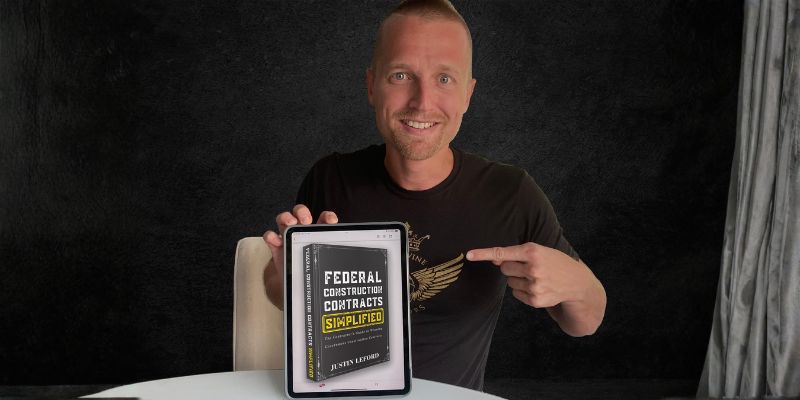
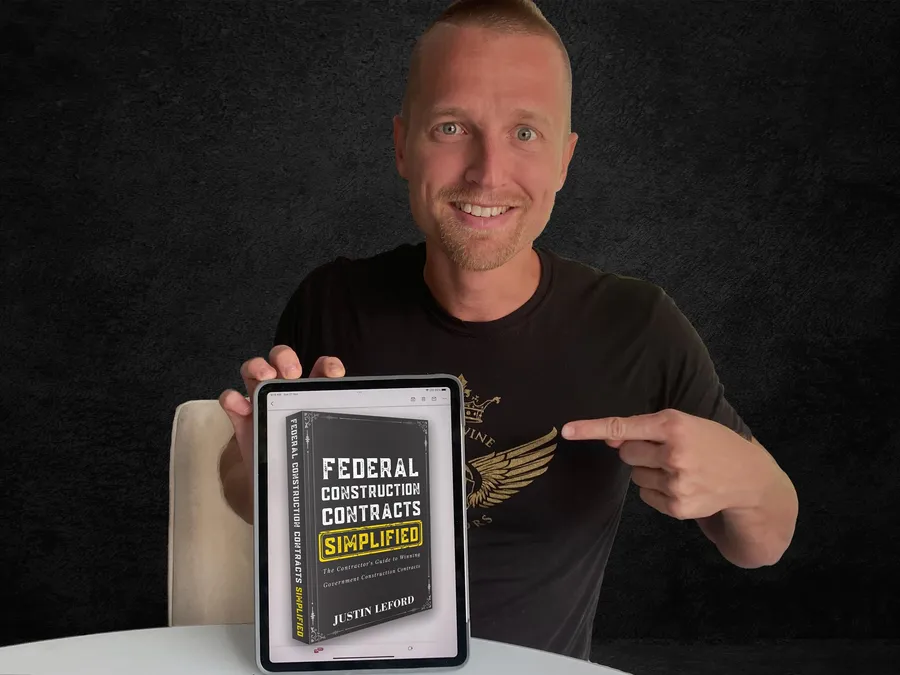
*Federal Construction Contracts Simplified* is the #1 best-selling book on government construction contracts, written by Justin Ledford — who won $1M in contracts working part-time over nine months, and whose clients have gone on to $100M in contracts. It lays out the 4-Part Government Construction Method for contractors across 18+ trades: how to get registered, how to find the right work, how to bid it, and how to run it once you win.
The digital copy is $7.95, it carries a 30-day guarantee, and the next 9 people also get the audiobook.
Claim your copy for $7.95 — order it directly at federalconstructioncontractssimplified.com. This book is not sold on Amazon.